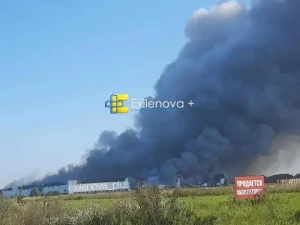
(MOSCOW) – Ukrainian long range drones have struck a major warehouse belonging to Russian online retail giant Wildberries for the second time in just over a month. Authorities say the warehouse in the Tambov region, southeast of Moscow, was completely destroyed in the resulting fire.
Ukrainian forces previously hit the depot on 18th July. Earlier this week, the Russian dictator Vladimir Putin signed a decree allowing the government to temporarily take control of critical infrastructure facilities if owners fail to protect them from drone attacks or restore them after such attacks.
Kremlin spokesperson Dmitri Peskov stated: “We are facing a clear threat of drone attacks targeting facilities and critical infrastructure, specifically sites that are vital to our country’s economy and social sector. Often business owners do not pay enough attention to taking measures to ensure safety. Anti-drone safety.”
Losses linked to drone strikes on Wildberries warehouses alone are estimated at up to 800 billion roubles (£7.3 billion, $9.2 billion, €8.5 billion). Many of these facilities are financed through bank loans, including state controlled banks. When warehouses burn, the losses ripple through the financial system.
The deeper purpose of the decree appears to be shifting responsibility for wartime damage away from the state and onto private companies. The message is essentially that if a business suffers losses, it is because the owner failed to protect themselves from a war the state is fighting.
For private owners, the decree likely means less control over their assets. The Russian government avoids the term nationalisation. Instead, officials say companies may be placed under temporary external management. First Deputy Prime Minister Denis Manturov has insisted these measures do not lead to expropriation, but uncertainties remain.
There is no clear definition of which companies qualify as vital or strategically important. This makes it what Russians often call a “rubber law,” legislation broad enough to be interpreted almost however the authorities choose.
Warehouses are highly vulnerable targets. They are often filled with combustible goods stored on large pallets, and their design can allow fires to spread quickly once ignited. A single successful strike can destroy large quantities of goods within hours.
The Russian government is discussing support measures. The central bank has recommended that commercial banks provide relief to small and medium sized businesses affected by drone attacks. Several ministries are working on assistance programmes. However, analysts say it would be difficult to compensate for losses on this scale. Wildberries may have lost roughly 20 percent of its warehouse capacity.
The decree also reflects the Kremlin’s effort to regain control of the narrative. For years, the Kremlin described the conflict as a “special military operation,” with the burden falling mainly on professional soldiers and the military. But when the consequences include state intervention in private businesses, damage to critical infrastructure and extraordinary economic measures, Russians increasingly experience it as war affecting the entire country.

Be First to Comment