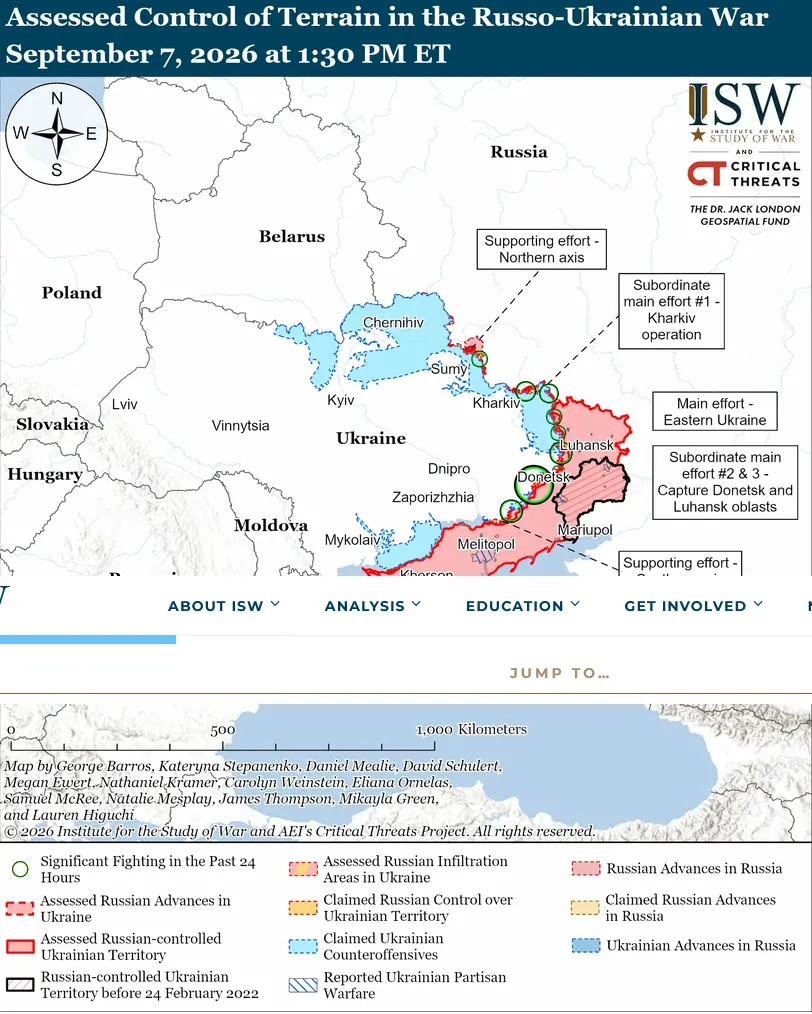
(KYIV) – The widespread culture of lying within the Russian armed forces is paradoxically harming Russia’s ability to fight effectively while simultaneously supporting the Kremlin’s exaggerated claims about battlefield gains. This is according to a report by the Institute for the Study of War (ISW).
Russian milbloggers continue to highlight the consequences of this pervasive culture of lying, which they refer to as the creation of “good reports” that exaggerate the scale of Russian advances to such an extent that they harm military operations.
However, the Kremlin continues to insist on its delusional portrayal of the current battlefield as the basis for negotiations, demanding Ukraine’s complete capitulation and the withdrawal of its troops from all of the Luhansk, Donetsk, Zaporizhzhia, and Kherson regions, including large and densely populated areas that Russian forces have not yet occupied.
The Russian dictator Vladimir Putin has shown that he is sensitive to accusations of being detached from the current realities of the battlefield in Ukraine. However, he continues to make absurd claims about fabricated Russian gains.
The Kremlin’s continued willingness to tolerate and seek to benefit from the widespread lying of the Russian military continues both to harm its own ability to fight effectively and to fuel its insistence that it is capable of achieving all its objectives by military force, ISW notes.
Negotiations to ensure a strong and lasting peace cannot be based on Russian lies. They can be based only on the realities of the battlefield and the trajectory of the war, which is unfavourable to Russia.
The Ukrainian military demonstrated the falsity of one of the Russian dictator’s more outrageous claims of fictitious Russian gains in Donetsk Oblast. Ukrainian 3rd Army Corps Commander Brigadier General Andriy Biletskyi published a video on 7th September showing himself calmly speaking in Svyatohirsk, north of Slovyansk, demonstrating unchallenged Ukrainian control over that settlement contrary to the Russian dictator’s claims on 1st September that Russian forces had seized it.
Biletskyi stated that Ukrainian forces comfortably control Svyatohirsk and that Ukraine considers the settlement to be in its rear area. ISW has observed evidence indicating that the closest Russian forces were 13 kilometres away from Svyatohirsk in late spring and early summer 2026. Numerous reports indicate that the current Russian line is even further away amidst ongoing Ukrainian counteroffensive operations.
A Russian source published archival and doctored footage on 5th September purporting to show Russian control over Svyatohirsk, presumably to support the false claims. However, a Russian milblogger responded to this footage on the same day and denied that Russian forces maintain positions even close to Svyatohirsk.
A Kremlin-affiliated milblogger acknowledged on 7th September that Biletskyi’s video was a clear demonstration of Ukrainian control over Svyatohirsk and observed that the Russian military command and the agencies responsible for Russian cognitive warfare efforts should have realised how easy it would be for Ukrainian forces to dispel the grossly exaggerated claims in this area.
The milblogger noted that false reports of captured settlements such as Svyatohirsk create operational risks for Russian forces because they cannot call for strikes on locations they claim to control and because units in adjacent sectors may plan operations based on this inaccurate battlefield picture. The milblogger noted that Russia’s failure to impose accountability for such dishonesty will increase deceptive reporting and may produce even strategic consequences.
Ukrainian forces recently advanced in the Slovyansk direction and the Kostyantynivka-Druzhkivka tactical area. Ukrainian forces advanced northeast of Stepanivka, south of Druzhkivka, and maintain positions in Stepanivka, according to geolocated footage published on 30th August.
Russian sources continue to heavily exaggerate the extent of Russian advances in the Kostyantynivka-Druzhkivka tactical area, contrary to all available evidence. A Telegram channel associated with the Russian 3rd Combined Arms Army published footage on 5th September claiming to show a strike against a Ukrainian position in Oleksiievo-Druzhkivka, northwest of Kostyantynivka, but the Ukrainian position was geolocated to northwestern Kostyantynivka. The Russian dictator previously claimed that Russian forces had seized Kostyantynivka as of 3rd July. Russian forces still have not seized all of Kostyantynivka as of 7th September, over two months after the claim.
Russia launched 92 drones against Ukraine overnight. Ukrainian forces continued their long-range strike campaign against Russian military assets and oil infrastructure on the night of 6th to 7th September. Ukrainian President Volodymyr Zelensky reported on 7th September that Ukrainian forces struck oil refineries in the Republic of Tatarstan and Perm Krai, a Russian storage and launch site for strike drones in Kursk Oblast, and an unspecified target in the Black Sea.
Perm Krai Governor Dmitry Makhonin confirmed Ukrainian strikes in Perm Krai. NASA Fire Information for Resource Management System data from 7th September shows heat anomalies at the Taganrog Airbase in Rostov Oblast, roughly 160 kilometres from the frontline, following reports of Ukrainian strikes in the area.
Russian forces continued offensive operations in northern Kharkiv Oblast on 6th and 7th September but did not advance. An officer of a Ukrainian unit operating in the Vovchansk direction stated on 7th September that Russian forces are intensifying attacks in the area ahead of a seasonal change, as they are aware that upcoming green cover loss in the autumn will preclude Russian infiltrators from hiding from Ukrainian drones and hinder Russian advances.
Ukrainian Joint Forces Task Force Spokesperson Colonel Viktor Trehubov stated on 7th September that Russian forces did not even reach the southern outskirts of Vovchansk, northeast of Kharkiv City, and advanced only between three and five kilometres from the international border in the Vovchansk and Velykyi Burluk directions, indirectly but clearly refuting Russian claims.
Russian forces are reportedly postponing their objective of seizing Kupyansk until spring 2027, according to a source reporting on the Russian Western Grouping of Forces, likely due to recent successful Ukrainian counterattacks and advances near Kupyansk.
The Ukrainian General Staff reported on 7th September that Ukrainian forces struck Russian command posts in occupied Nyzhnii Naholchyk, roughly 109 kilometres from the frontline, and Dovzhanske, roughly 142 kilometres from the frontline, and an ammunition depot near occupied Teple, roughly 95 or 118 kilometres from the frontline. Ukraine’s Special Operations Forces reported that the ammunition depot near occupied Teple supplied units of the Russian 8th Combined Arms Army.
In the Kherson direction, Russian forces continue to employ “human safari” tactics, purposefully hunting civilians in Kherson City. Ukrainian Kherson City officials reported on 7th September that Russian forces struck a public transportation stop in Kherson City, injuring one person. Russian forces dropped grenades using rotary drones on two civilians in Kherson City and one in Antonivka, just east of Kherson City, according to geolocated footage published on 7th September.
The Ukrainian General Staff reported on 7th September that Ukrainian forces struck a railway bridge across the North Crimean Canal near occupied Vladyslavivka, roughly 230 kilometres from the frontline, which Russian forces used for logistics. Ukraine’s Main Military Intelligence Directorate Department of Active Operations reported on 7th September that drone operators struck and damaged a Russian aircraft, reportedly a Su-24 tactical bomber, in occupied Crimea overnight on 6th to 7th September.
The Ukrainian Air Force reported on 7th September that Russian forces launched 92 Shahed-type strike drones, including jet-powered variants, Gerbera-type strike drones, Parodiya-type decoy drones, and S8000 Banderol-type loitering munitions from the directions of Oryol City, Primorsko-Akhtarsk in Krasnodar Krai, occupied Donetsk City, and occupied Hvardiiske in Crimea. Ukrainian forces downed 71 drones, aerial vehicles hit 12 locations, and debris fell on one location. Ukrainian officials reported that Russian forces struck civilian and logistics infrastructure in Chernihiv, Dnipropetrovsk, Kharkiv, Kherson, Kyiv, Odesa, and Zaporizhia oblasts.
Russia’s political leadership seeks to capture Donbas by the end of 2026, while the military is asking to move the deadline to 31st March 2027. This was reported by Pavlo Palisa, Deputy Head of the Office of the President of Ukraine.
Be First to Comment