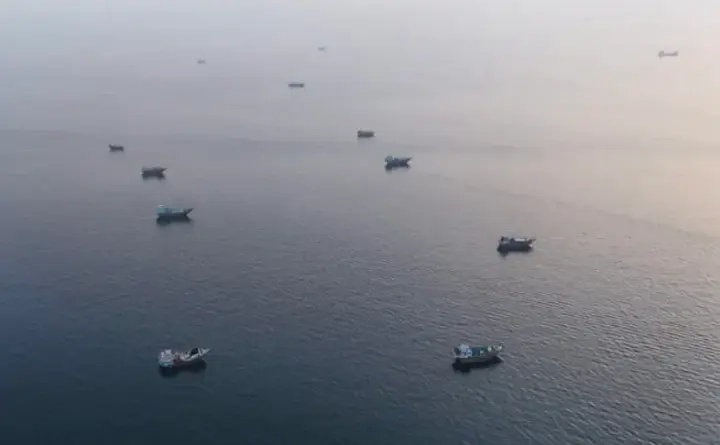
(TEHRAN, IRAN) – Iran’s Islamic Revolutionary Guard Corps Navy has announced the closure of the Strait of Hormuz until further notice and warned that no vessels will be allowed to pass through the waterway. The declaration was carried by Iranian state media and reported by The Times of Israel.
The decision was taken in response to what Tehran described as American interference in the region. Iranian naval forces fired a warning shot at a vessel that allegedly attempted to use an unauthorised route through the strait. According to Iranian accounts, the ship stopped after the shot was fired. The Revolutionary Guard stated that any enemy using the closure as a pretext for a mistake would face a harsh response.
The Strait of Hormuz is one of the world’s most critical maritime choke points. A significant portion of global oil and liquefied natural gas shipments passes through the narrow waterway, which connects the Persian Gulf with the Gulf of Oman and the Arabian Sea. Any prolonged disruption to traffic would have immediate consequences for global energy markets and the broader shipping industry.
The closure follows a period of escalating tension between Washington and Tehran. The administration of US President Donald Trump had given Iran a one day deadline to publicly acknowledge that the strait was open and to commit to ceasing attacks on commercial vessels. According to a report by Axios citing unnamed US officials, that message was conveyed directly to Iran’s leadership through regional intermediaries.
The White House has claimed that Iran violated a memorandum of understanding signed with the United States three weeks prior by repeatedly firing on commercial ships in and around the strait. American officials have argued that Iran’s failure to meet a direct commitment raises serious doubts about its willingness and ability to implement a more complex nuclear agreement.
Iranian Foreign Minister Abbas Araghchi and Omani Foreign Minister Badr al Busaidi were expected to meet on Saturday in Muscat to discuss the Hormuz crisis. In recent weeks, Oman joined forces with the United States and Gulf allies to open a southern channel near its coast for vessels to transit the strait, a move that reportedly enraged Tehran. Iranian negotiators told American officials that radical elements within the regime had opened fire on vessels in an attempt to regain leverage.
Publicly, Iranian negotiators, Revolutionary Guard commanders and other senior officials have been united in their demand that Tehran retain control over shipping through the strait. The closure appears to be the most forceful expression yet of that position.
Satellite imagery obtained and analysed by CNN in cooperation with the Institute for Science and International Security has indicated that Iran is likely rebuilding nuclear facilities after strikes by the US military. The images raise further questions about Tehran’s compliance with the memorandum signed with Washington.
President Trump has stated that the United States agreed to Iran’s request to continue negotiations but confirmed that the ceasefire is no longer in effect. He also noted that plans for alternative options are being developed should a nuclear deal not be reached.
No local currency figures were relevant to this report. The economic impact of a sustained Strait of Hormuz closure would be measured in global oil prices and shipping costs. For context, crude oil prices have historically spiked by several dollars per barrel during periods of heightened tension in the strait.
Be First to Comment