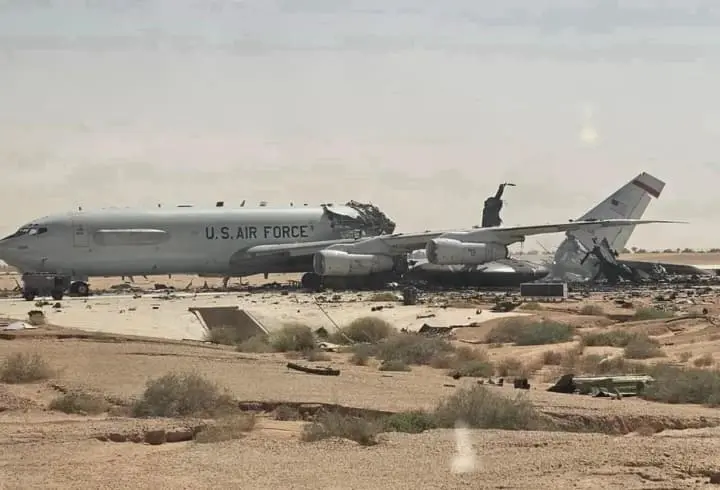
(WASHINGTON, D.C.) – Iranian missile and drone strikes have caused an estimated $3.7 billion (£2.9 billion) in equipment losses to United States military facilities across the Middle East, with nearly 60 aircraft damaged, according to an assessment by the Pentagon’s inspector general.
New photographs obtained by CBS News show extensive destruction at American bases in Saudi Arabia and Kuwait. The images, provided by US service members on condition of anonymity, reveal destroyed buildings, barracks, vehicles and aircraft.
At Prince Sultan Air Base in Saudi Arabia, a US Boeing E-3 Sentry airborne early warning and control aircraft was directly hit. The photograph shows a burned fuselage with the tail section torn off.
Significant destruction was also recorded at Camp Buehring in Kuwait, used to house US ground forces, armoured vehicles and aircraft. The photographs show destroyed vehicles and trailers, as well as damaged buildings. Damage was also documented at Arifjan Camp.
A report by the inspector general of the US Department of Defense states that Central Command reported Iranian strikes on US bases in Kuwait, Bahrain, Qatar, the United Arab Emirates, Saudi Arabia, Iraq, Oman and Jordan.
One US service member told CBS News that the extent of the damage had not previously been fully presented to the public. The Pentagon did not respond to the network’s inquiry regarding the released photographs.
The war with Iran has already cost American taxpayers $38 billion (£29.8 billion) in just the first five months of hostilities, with each subsequent month potentially adding at least $2–3 billion (£1.6–2.4 billion) in expenses, according to a new estimate by the US Congressional Budget Office cited by Bloomberg.
The $38 billion figure includes the costs of replacing used munitions and lost equipment, additional aircraft flight hours and fuel. The CBO was unable to estimate the cost of repairing or restoring damaged US military bases, meaning actual expenses could be higher.
The conflict is also expected to affect prices in the United States. Due to disruptions in oil and gas supplies through the Strait of Hormuz, the CBO expects the key inflation measure to be approximately 0.5 percentage points higher at the beginning of 2027 than forecast before the conflict began. Core inflation could be 0.3 percentage points higher.
The CBO describes the depletion of US munitions stockpiles as one of the most serious consequences of the hostilities. Replenishing them could take five years or more. Such a shortage could become particularly dangerous in the event of another major conflict with an adversary possessing significant stockpiles of ballistic and cruise missiles. The report mentions a conflict over Taiwan as one possible scenario.
US President Donald Trump previously stated that the country had a “practically unlimited quantity” of munitions. However, estimates by the CBO and the Pentagon inspector general point to problems replenishing certain types of weapons.
In July, Republicans in the House of Representatives proposed allocating another $73 billion (£57.3 billion) to the military and intelligence services for direct expenses related to the war in Iran. Consideration of this funding has currently stalled in the Senate.
Meanwhile, the Trump administration is cutting military aid to Europe and the Middle East to support governments with conservative views in Central and South America. The State Department informed Congress on Tuesday that it would reallocate $52 million (£40.8 million) earmarked to fund the armed forces of Slovakia, North Macedonia, Tunisia and Iraq to Panama, Peru, Ecuador and Colombia.
Last week, Secretary of State Marco Rubio visited Colombia, Ecuador and Peru and promised them additional support, as the Trump administration’s foreign policy prioritises the Western Hemisphere, focusing on combating drug trafficking and illegal immigration.
This is merely the latest in a series of steps aimed at reducing funding or deploying troops in Europe in response to President Donald Trump’s complaints that NATO allies are not allocating sufficient funds to their defence budgets, as well as over other issues.
The State Department said the funds would be used to “combat narco-terrorism in our own backyard and help continue ensuring the security of the Panama Canal,” adding that the Western Hemisphere has historically not received US military aid.
US President Donald Trump is “ready” for talks with Iran and insists that other countries should reimburse the United States for costs related to oil transported through the Strait of Hormuz.
Be First to Comment